U.S. Virgin Islands History: What to Know Before Visiting St. Thomas, St. John & St. Croix
The U.S. Virgin Islands: A History of Three Islands

Before you pack your bags for St. Thomas, St. John, or St. Croix, it helps to know the incredible story behind the islands you are about to explore. Long before European ships ever spotted these shores, vibrant Indigenous communities called them home. Over the centuries that followed, waves of exploration, pirate raids, colonial power struggles, sugar plantations built on enslaved labor, fierce resistance, emancipation, and the shift from Danish to American rule all left a lasting mark on the landscape and culture you see today.
More than dates and flags, though, this is the story of the real people who lived through it all: Indigenous islanders, sailors and settlers, plantation families, enslaved men and women, free workers and merchants, and the generations who built their lives here afterward. Their experiences could not have been more different, yet together they shaped St. Thomas, St. John, and St. Croix into the U.S. Virgin Islands we love visiting today.
In this article:
1. The First Islanders
2. First Contact & the Contest for the Islands
3.Pirates, Privateers, and the Virgin Islands
4. Denmark Builds a Colony
5. The 1733 Uprising on St. John
6. Rebuilding & the Sugar Boom
7. The Road to Emancipation
8. From Emancipation to Transfer
9. A New Flag. A Changing Territory.
10. The Virgin Islands Today
A Note on Our Historical Approach
This article follows the available historical evidence while recognizing that surviving records are incomplete and often reflect the institutions that held power. It does not soften the realities of violence, forced labor, resistance, or the hardships faced by people living within the colonial system. Those experiences varied widely, and historical context helps explain people's choices without excusing harm. Where the evidence is uncertain, we say so. Our goal is to share a careful, honest account of the people and events that shaped these islands, without assigning inherited blame or defending a present-day political position.
The First Islanders
Before European Arrival, c. 1500 BCE–1493 CE.
People lived in the Virgin Islands thousands of years before European ships arrived, though the oldest traces are fragmentary and leave no single "first arrival" on record. On St. John, one of the earliest known sites sits near Lameshur Bay, where early inhabitants hunted, fished, and gathered wild foods, moving between locations as they used the islands' resources. No record survives of what they called themselves or what language they spoke.
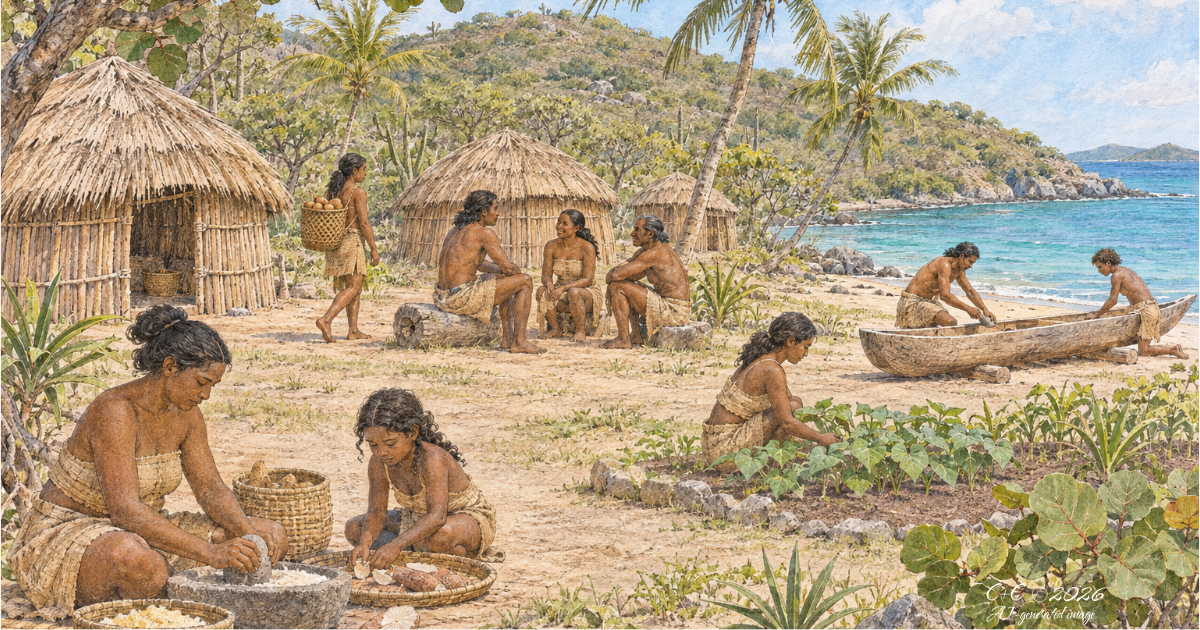
Pre-Contact Caribbean Coastal Village
Over generations, new groups arrived and established communities changed. Later migrants brought farming, pottery-making, and seafaring traditions rooted in northern South America. They cultivated crops, harvested shellfish, crafted stone and clay tools, and traveled by canoe between neighboring islands. Archaeologists group their pottery styles and cultural patterns under labels like Saladoid and Ostionoid to organize the physical evidence, which points to active trade across the Caribbean alongside distinct local settlements.
That physical record looks different across each of the three main islands:
- St. Croix: Salt River Bay preserves traces of several pre-contact communities, including pottery, carvings, and a ceremonial ball court. While a recent study proposed a very early date for a pottery shard found at Richmond, researchers note that dating methods and older excavation records still leave parts of the early timeline open to revision.
- St. Thomas: The Tutu Archaeological Village shows that people lived in established settlements across long stretches of time, with evidence from two major periods of occupation including house remains, burials, food waste, and pottery.
- St. John: Sites at Coral Bay, Cinnamon Bay, Caneel Bay, and Lameshur Bay show that communities lived in coastal villages. Later residents grew crops like cassava and maize, made pottery and stone tools, and gathered at ceremonial spaces, leaving behind the carved petroglyphs at Reef Bay.
By the centuries leading up to 1493, communities commonly identified in historical and archaeological records as Taíno lived across parts of the Virgin Islands. Rather than a single uniform population, these were distinct communities with their own leaders, customs, and regional alliances. On St. John, the latest confirmed Taíno evidence dates to the mid-1400s, shortly before Columbus reached the region, though researchers still debate why settlement patterns shifted around that time.
Centuries before European colonization, these communities had already shaped the islands through agriculture, trade, village life, and ceremony, leaving physical traces in the soil and stone that remain visible today.
First Contact & the Contest for the Islands
c. 1493 - 1672
On November 14, 1493, members of Christopher Columbus’s second expedition came ashore at Salt River Bay on St. Croix looking for fresh water and a safe anchorage. The bay was already an established settlement and gathering site, and a violent clash quickly broke out between the landing party and the residents. Several people were killed on both sides. After meeting armed resistance, the expedition named the eastern point Cabo de las Flechas, or "Cape of the Arrows," marking one of the earliest recorded battles between Europeans and Indigenous peoples in the Americas.
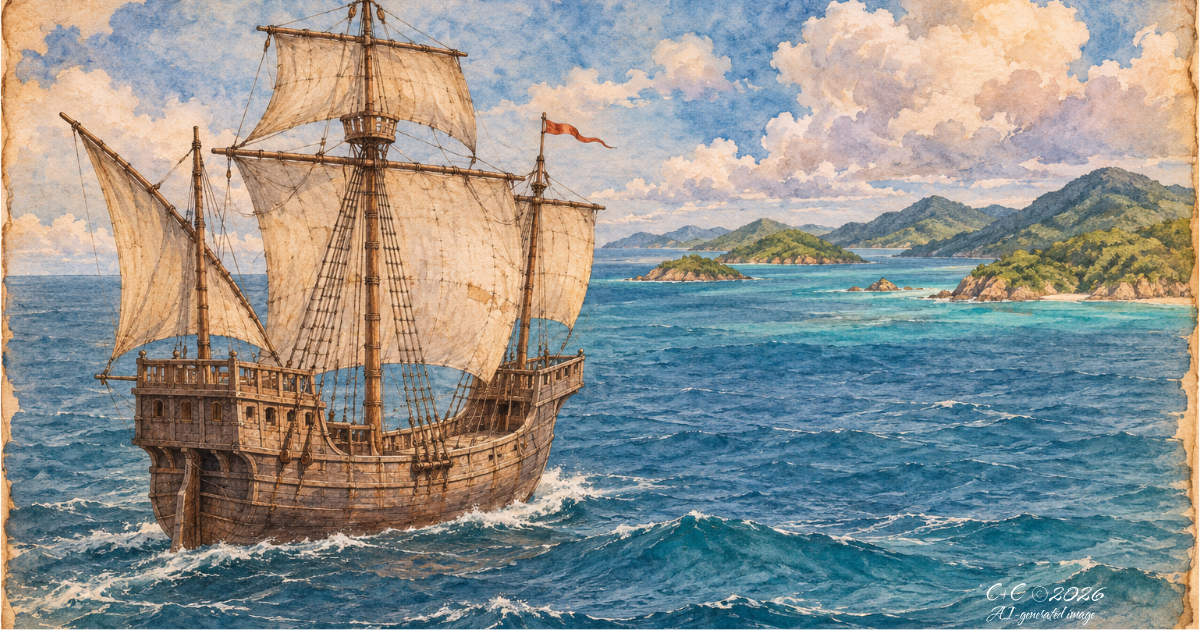
Late-15th-Century Nao Approaching the Virgin Islands
Columbus claimed and renamed the islands for Spain, calling St. Croix Santa Cruz ("Holy Cross") and naming the surrounding archipelago after Saint Ursula and the 11,000 virgin martyrs, a title later shortened to "the Virgins." Those European names went straight onto colonial maps and records, while the original Indigenous names for most places went unrecorded.
The people who fought the Spanish at Salt River included Kalinago residents whose presence in the region predated Columbus by centuries. Archaeological evidence on St. Croix shows that Taíno and Kalinago communities interacted through both trade and conflict, trading goods, adapting customs, and competing over territory and sea routes rather than simply replacing one another in neat stages.
Spanish arrival brought a wider wave of disruption. Armed raids, forced removals, and introduced diseases fractured local communities and weakened their ability to hold territory, while Spanish officials used labels and accusations from early expedition reports to justify conquest and enslavement. Because surviving written accounts come mostly from the powers seeking control, much of the Indigenous perspective was left out of the written record.
Although Spain claimed the islands, rival European powers soon moved into the area. English, Dutch, and French expeditions repeatedly tried to establish footholds, only to be driven out by warfare, disease, and imperial competition. By the 1600s, the islands' deep harbors and location along major Caribbean shipping lanes made them prime targets for nations chasing trade and strategic ports. After a first Danish settlement attempt on St. Thomas failed in 1665, Denmark returned in 1672 and established a permanent foothold.
Pirates, Privateers, and the Virgin Islands
c. 1500s - early 1700s
The Virgin Islands’ geography made them valuable to more than the people living on them. Dozens of small islands, sheltered coves, steep hills, and proximity to Puerto Rico gave ships places to anchor, hide, make repairs, and watch major sea lanes. As European powers fought for control of the Caribbean during the 16th and 17th centuries, the islands sat right in the middle of that struggle.
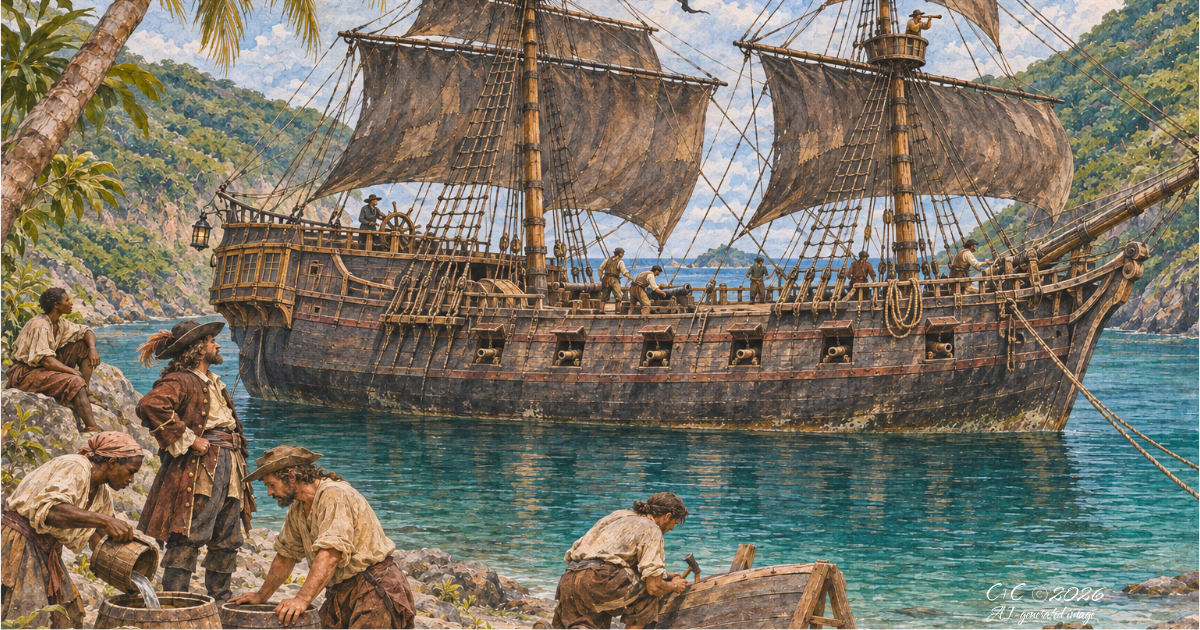
Pirate Ship in a Tropical Cove
While privateers carried government commissions to attack enemy ships during wartime and pirates operated without legal backing, the line between the two frequently blurred, as a captain treated as a lawful privateer by one crown was hunted as a criminal pirate by another.
Operating out of Virgin Islands anchorages, French, Dutch, and English raiders targeted Spanish ships and settlements, including routes tied to Puerto Rico. Driven by profit and imperial rivalry, these raids challenged Spain's claims and wealth, turning the islands' strategic harbors into targets for violence and Spanish retaliation.
Protected coves on St. John and St. Thomas regularly offered refuge to sea raiders. Archaeological and historical research by the National Park Service confirms that buccaneers and pirates used both islands for shelter during the decades of competing European claims.
Early Danish settlement did not stop that activity. Denmark’s first attempt to colonize St. Thomas in 1665 collapsed after raiders attacked the settlers and stole their supplies and ammunition. When Denmark returned in 1672, its policy of neutrality opened St. Thomas to ships and merchants of all nationalities. While neutrality boosted legitimate commerce, it also drew illicit trade: National Park Service records show that pirates and privateers traded and sheltered in Danish waters, and pirates from Tortuga once blockaded and plundered St. Thomas Harbor.
Historical records link several notorious captains to the Virgin Islands, including Jean Hamlin, Captain Kidd, Bartholomew Sharp, Stede Bonnet, and Black Sam Bellamy. While the documentary evidence varies for each figure and later folklore added plenty of embellishment, real raids brought theft, captivity, injury, and death to crews at sea and residents ashore.
Piracy was one piece of a much broader maritime economy. The same harbors that hid raiders also supported colonial trade, naval defense, and the forced transport of enslaved Africans, tying the islands' ports to both commercial opportunity and colonial coercion.
Denmark Builds a Colony
c. 1672 - 1733
Denmark’s lasting foothold began on St. Thomas in 1672, when a ship sent by the Crown-chartered Danish West India Company arrived and raised the Danish flag. The company was after Caribbean trade and crops that couldn't grow in northern Europe. While St. Thomas’s deep harbor made it a natural port, its steep terrain made large-scale sugar cultivation difficult, a challenge neighboring St. John shared.
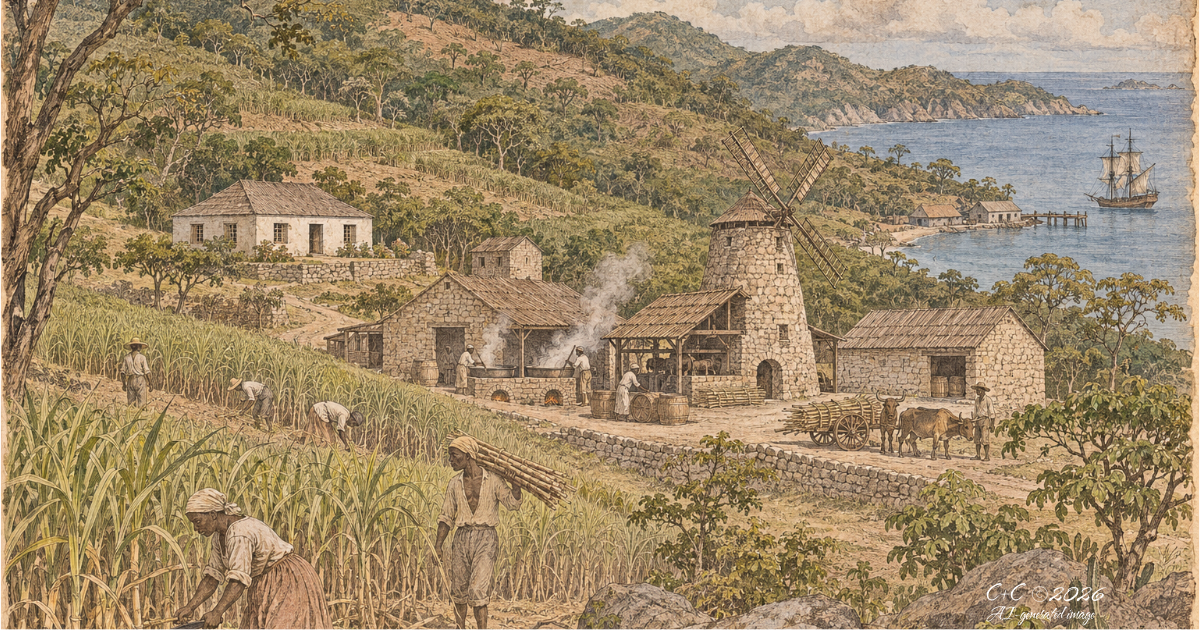
St. John Sugar Estate c.1728
St. Thomas became a busy trading center. The company also established a market where enslaved people brought from Africa were sold. They had been forcibly transported across the Atlantic and were made to work in the colony’s ports, households and plantations. Some were assigned to grow food on small provision plots, but this did not make their labor or lives their own. Enslavement was part of the colony’s economic design from its early years.
Though Denmark claimed St. John in the late 1600s, formal settlement didn't begin until 1718, when planters, soldiers, and enslaved people landed at Coral Bay and carved the island into estates. Sugar took hold along parts of the north shore, while other areas produced cotton, tobacco, and food crops. To farm St. John’s steep hills, growers cleared much of the island's timber and cut terraces straight into the slopes. Within a decade, the island was divided into roughly 109 estates.
Plantation owners faced real pressures. Starting an estate required land, equipment, labor and access to markets. St. John’s steep ground demanded substantial work, and the colony was exposed to drought, hurricanes, crop pests and changing prices. A failed harvest could threaten an owner’s income and leave a family or business in debt. At the same time, the plantation system transferred much of the cost of survival onto enslaved people: on St. John, owners expected them to grow food for themselves, often on less productive land. When drought and a hurricane destroyed crops in 1733, enslaved people faced hunger as well as forced labor and harsh punishments.
St. Croix entered the Danish colony in 1733, after Denmark purchased the island from France. Its broader, more fertile coastal plain was better suited to sugar than the hilly terrain of St. Thomas and St. John. Danish rule would bring a new wave of plantation development there, with towns and estates laid out to serve that economy.
By 1733, the colony’s residents had been shaped by very different conditions: merchants and planters were trying to make fragile ventures succeed, while enslaved people were compelled to sustain those ventures through labor and live under the rules imposed on them. Drought, a devastating hurricane, crop-destroying insects and increasingly harsh restrictions formed the immediate backdrop to the uprising that began on St. John that November. That revolt, and the courage and consequences surrounding it, deserves its own chapter.
The 1733 Uprising on St. John
c. 1733 - 1734
The uprising began after years of enslavement, forced labor and resistance. In 1733, drought, a hurricane and crop-destroying insects devastated St. John’s harvests. Enslaved people, whom plantation owners expected to grow much of their own food on small provision plots, faced hunger. Plantation owners also suffered crop losses and damage to their estates. Then Governor Philip Gardelin’s new Slave Code imposed brutal penalties for defiance, including flogging, amputation, torture and execution. These pressures fell on people in profoundly different ways: the owners feared the loss of their property and control; enslaved people faced the violence of a system that denied them freedom and made survival precarious.
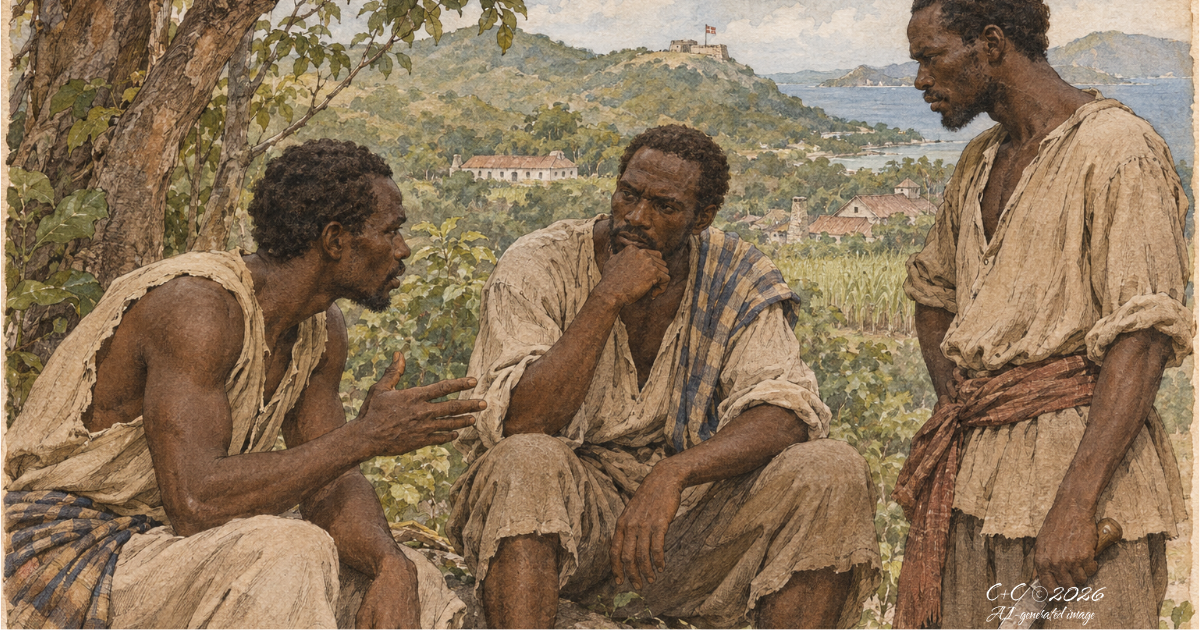
Three Akwamu Leaders on St. John
Before dawn on November 23, a group of enslaved people entered the Danish fort at Coral Bay carrying bundles of firewood with cane knives hidden inside. They caught the soldiers off guard, seized the fort, and fired its cannon to signal the start of the revolt. Moving across the island in an organized push, the fighters attacked plantations to overthrow colonial rule and take control of the estates. Many of the fighters were Akwamu people taken from their homeland in present-day Ghana.
Not every enslaved person on St. John joined the revolt, as the island’s enslaved population came from different West African nations with their own histories and rivalries. According to National Park Service records, people listed by colonial authorities as belonging to the "Accra" nation (a broad label tied to the Gold Coast around modern-day Accra, likely encompassing Ga-Adangbe communities) feared Akwamu leaders would dominate them if the uprising succeeded, echoing earlier power dynamics in West Africa. While some from this group joined the fighters, others stayed out of the revolt or helped defend the refuge at Pieter Durloo’s estate.
Danish forces struggled to regain control. They drove back a British force sent from Tortola, and the resistance held out for months until Denmark secured French military support from Martinique. French troops finally helped crush the uprising in 1734. Historical accounts note that some freedom seekers chose death near Ram Head rather than capture, though sources differ on the exact numbers and circumstances. Those taken alive faced torture and public execution, including some who had been promised clemency.
Once the revolt was put down, Danish authorities restored the plantation system. Planters returned to ruined estates and heavy financial losses, while surviving enslaved people faced brutal reprisals and tightened control. Depending on how historians measure the final holdouts, the uprising lasted between six and nine months, though gaps in colonial record-keeping leave many details of the fighters' plans undocumented.
Rebuilding & the Sugar Boom
c. 1734 - 1803
After putting down the St. John uprising, Denmark began colonizing St. Croix in 1734. Its broad, fertile coastal plain was far better suited to sugar cultivation than the steep hillsides of St. John and St. Thomas. The Danish West India and Guinea Company surveyed St. Croix into plantation lots, established Christiansted as its administrative center, and rebuilt the plantation economy on the labor of enslaved workers.
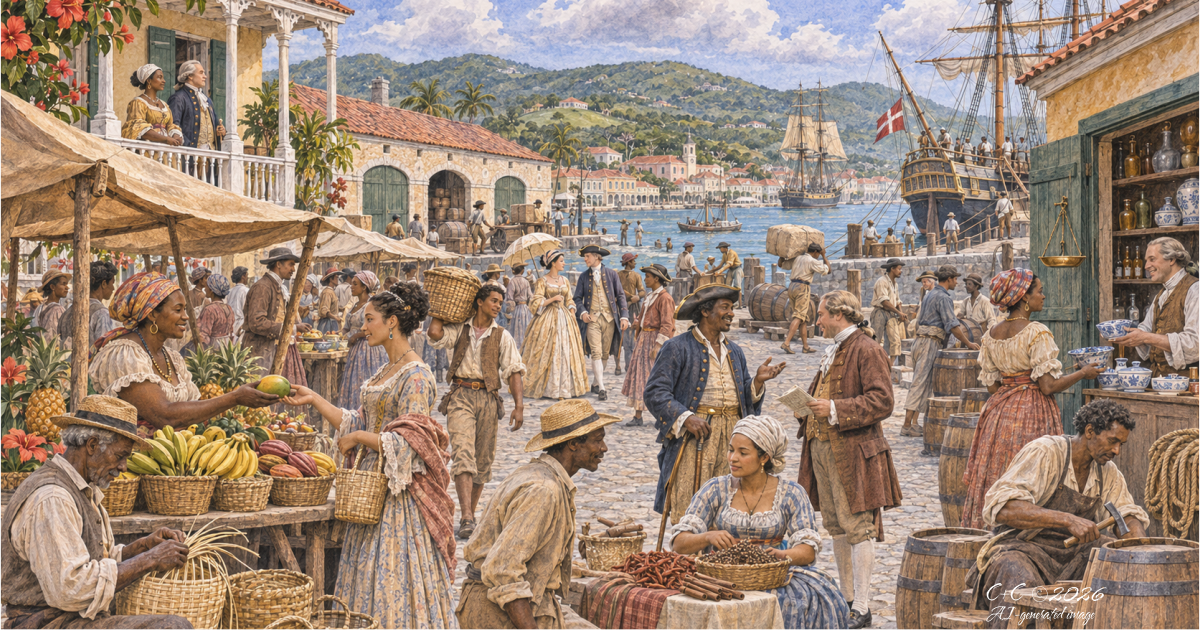
Bustling Danish Caribbean Port Marketplace
The early company years were tough on settlers and investors. From 1734 to 1754, the company taxed imports and exports heavily and required all trade to move on Danish ships, keeping economic growth slow and discouraging new arrivals. In 1754, the Danish Crown bought out the company and took direct control of the colony. Crown rule opened the door to stronger trade and higher sugar output, while keeping the coercive labor system firmly in place.
Over the next few decades, each island took on a distinct economic role. St. Croix became the main sugar producer, anchored by estates, mills, and the port towns of Christiansted and Frederiksted, while St. John continued operating plantations despite its rugged terrain. St. Thomas grew into a commercial hub, especially after Charlotte Amalie was declared a free port in 1764, drawing ships from multiple nations and supporting a busy community of merchants, sailors, dockworkers, artisans, and colonial officials.
Beyond planters and enslaved field hands, colonial records also document fishers, boat operators, craft workers, soldiers, clergy, and free residents. Some free people earned a living through fishing or small trades, while others were poor and moved from estate to estate looking for work, as free status did not guarantee financial security or equal legal standing under colonial law.
What “Free” Meant in Colonial Records
In Danish West Indies records, “free” simply meant a person was not legally enslaved. The term covered both individuals born free and those who had gained or purchased their freedom. Free status indicated nothing about a person's wealth or social standing: Danish censuses distinguished between the freeborn and the formerly enslaved, listing occupations ranging from merchants, sailors, and craft workers to fishers and poor laborers with very little income. Even with legal freedom, residents still faced strict legal limits and unequal treatment under colonial law.
The Road to Emancipation
c. 1803 - 1848
After Denmark’s ban on the transatlantic slave trade took effect in 1803, the plantation system continued unchanged for the people already held in bondage. Over the next several decades, enslaved people resisted in multiple ways, including escaping into the hills to form independent communities or fleeing by water to nearby British islands. Once Great Britain abolished slavery in the British Virgin Islands in 1834, crossing the channel became an even stronger route to legal freedom.
Three Islands, Ships, and a Hopeful Sunset
On July 28, 1847, King Christian VIII announced a gradual emancipation plan for the Danish West Indies. Under the royal decree, any child born to an enslaved mother after that date was legally free from birth, while the mother remained enslaved and everyone else had to wait twelve more years for freedom. In practice, families remained split between free children and enslaved parents while the plantation system kept operating around them.
People refused to wait out the twelve-year timeline. In early July 1848, enslaved residents on St. Croix organized a mass uprising, with thousands gathering near Frederiksted to demand immediate freedom and making clear they would burn the town and surrounding estates if their demands were refused.
Faced with an island-wide revolt, Governor General Peter von Scholten issued a proclamation on July 3, 1848, declaring all enslaved people in the Danish West Indies immediately free. Rather than a top-down reform granted on Denmark's schedule, emancipation was forced by mass mobilization on the ground.
While the proclamation ended legal bondage, it did not dismantle the plantation economy overnight. Von Scholten's decree set immediate terms for the transition, stipulating that plantation work would now be paid by agreement, though former slaves still had to navigate an economy controlled by estate owners and colonial officials. On St. John, many left the estates altogether, relying on provisioning skills and community networks they had built during slavery to support themselves independently.
July 3, 1848, brought an end to legal slavery across the Danish West Indies, ushering in a new era defined by labor disputes, land ownership struggles, and the realities of life after emancipation.
From Emancipation to Transfer
c. 1848 - 1917
Emancipation ended legal slavery in the Danish West Indies, though it did not immediately deliver equal access to land, capital, or political power. On St. Croix, many formerly enslaved people remained on the estates where they had worked before 1848. In 1849, the colonial government enacted a strict labor law that fixed wages and restricted workers to changing jobs on only one day a year, October 1. The law secured a steady labor supply for planters while tightly limiting workers' freedom of movement and bargaining power.
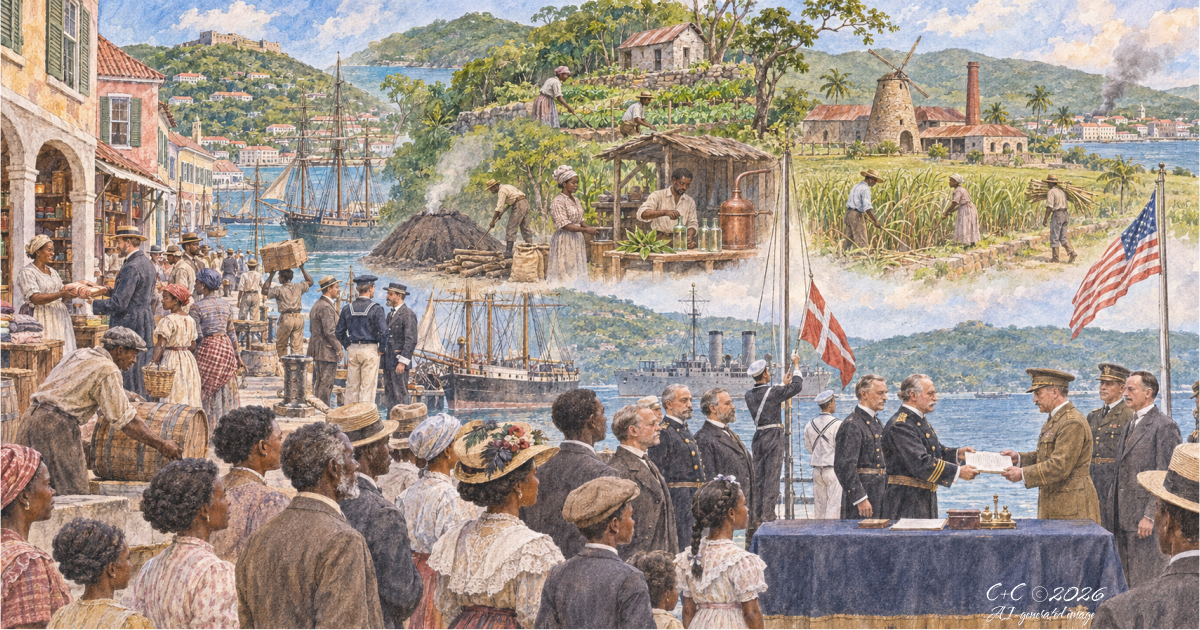
Three Islands, One Historic Transfer
At the same time, estate owners faced steep financial pressures of their own. Planters had to adjust to paying cash wages in a shrinking sugar market driven down by falling prices and growing competition from European beet sugar. Unable to stay profitable, some owners broke their estates into smaller farms or abandoned them altogether.
Daily life and work took different shapes across each island. On St. John, many residents left the estates and built independent livelihoods through small-scale farming, fishing, sailing, charcoal burning, and bay rum production. On St. Croix, large sugar plantations remained the backbone of the economy and relied on contracted wage laborers. St. Thomas centered on its harbor and commercial trade, where merchants, sailors, shopkeepers, artisans, and dockworkers served ships from across the Caribbean. Residents who had been free before 1848 also worked throughout the towns and ports, with living standards varying widely by trade, wealth, and social standing.
Resentment over fixed wages and strict labor contracts continued to build on St. Croix. On October 1, 1878, known as Contract Day, workers gathered in Frederiksted, where a clash with police escalated into an island-wide revolt. Fires swept through Frederiksted and the countryside, burning roughly fifty plantations and much of the town in an uprising known as Fireburn.
Women played a prominent role in the revolt, led by Mary Thomas, Agnes Salomon, and Mathilda McBean, known historically as the "Three Queens of Fireburn," alongside Susanna Abrahamson, known as "Bottom Belly," who was arrested with them. Colonial authorities violently crushed the uprising. While the revolt forced modest wage increases, disputes over labor laws and working conditions continued through the end of Danish rule.
Natural disasters and shifting geopolitics also unsettled the colony. In 1867, while Denmark and the United States were negotiating a possible purchase of the islands, a major hurricane, earthquake, and tsunami struck in rapid succession, causing widespread damage and derailing the proposed sale for another fifty years.
During World War I, the United States revived talks to buy the islands, seeking to protect strategic shipping routes near the Panama Canal. Denmark and the United States agreed on a price of $25 million in gold. On March 31, 1917, the transfer took effect, making the Danish West Indies a U.S. territory placed under U.S. Navy administration until 1931.
A New Flag, A Changing Territory
1917-2000
From Danish to U.S. Rule
Under U.S. Navy administration from 1917 to 1931, military priorities shaped early American governance while residents adjusted to a new legal system amid ongoing economic hardship. American citizenship came in stages: Congress extended U.S. citizenship to eligible residents in 1927 and expanded coverage in later laws. Local self-government moved slowly as well. The Organic Act of 1936 laid the groundwork for civil administration, and the Revised Organic Act of 1954 established a broader territorial government, though residents did not elect their own governor until 1970 or gain a nonvoting delegate to the U.S. House of Representatives until 1972.
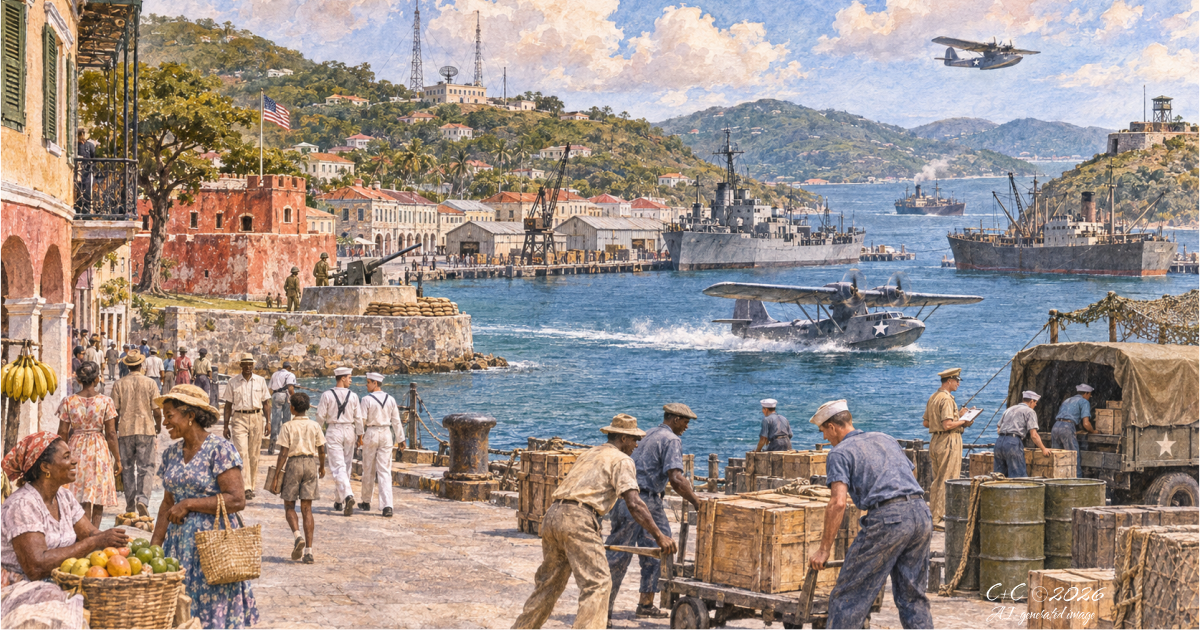
Charlotte Amalie Harbor in Wartime
Workers, the Press, and the Push for a Voice
The campaign for labor rights and local representation had already started under Danish rule. On St. Croix, labor leader David Hamilton Jackson organized workers and challenged restrictions on independent newspapers, securing permission from Danish authorities to launch The Herald in 1915, which brought wages and working conditions into open public debate.
Women also fought for equal political standing. Even after the Nineteenth Amendment took effect in the United States in 1920, local legal barriers kept women in the Virgin Islands from voting until a 1935 court ruling secured their voting rights on the same terms as men, placing women on the voter rolls in 1936.
Economic strain deepened during the Great Depression. Federal emergency relief and public works programs created temporary jobs and infrastructure support, though the islands remained heavily dependent on outside capital and federal policy decisions.
St. Thomas: Port, Wartime Hub, and Visitor Center
St. Thomas continued to rely on Charlotte Amalie’s harbor and maritime trade. During World War II, the island became a major hub for U.S. and Allied operations in the Caribbean, supporting military communications, supply depots, seaplane and aircraft bases, submarines, and harbor defenses that brought both federal jobs and a heavy military presence into daily life.
After the war, St. Thomas shifted toward tourism and passenger travel. Charlotte Amalie became a major port of call for cruise ships, creating jobs in shops, hotels, restaurants, transportation, and marine services while tying the local economy closely to outside travel companies and visitor demand. The opening of a new Cyril E. King Airport terminal in 1990 underscored how central air travel had become.
St. John: Rural Livelihoods and Conservation
St. John remained far more rural than St. Thomas, with families making a living from cattle raising, fishing, small farms, charcoal burning, and bay oil production. A small resort opened at Caneel Bay in 1935, marking an early foothold for tourism. Two decades later, land acquired by Laurance Rockefeller and the Jackson Hole Preserve was donated to the federal government, leading Congress to establish Virgin Islands National Park in 1956 and expand its protected waters in 1962. As visitors arrived in growing numbers, the park preserved large stretches of land and reef alongside St. John's established local communities.
St. Croix: Sugar, Industry, and Change
St. Croix’s economy took a different course as plantation agriculture struggled against falling sugar profits and outside competition. In the mid-1960s, a massive oil refinery opened on the island, bringing major outside investment and industrial jobs while reshaping land use and introducing environmental challenges. An alumina plant built in the early 1960s also employed hundreds of workers until it closed in 2000.
Moving away from agriculture reshaped the workforce unevenly. While many residents found jobs in hospitality, manufacturing, government, or port operations, others faced uncertain transitions as traditional farming shrank, leaving business owners, farmers, and families tied to global markets and outside investment.
Hurricanes and Rebuilding
Major hurricanes repeatedly damaged homes, farms, businesses, ports, and utilities across the territory. In 1928, the San Felipe II hurricane battered the islands with sustained winds near 90 miles per hour on St. Thomas, driving small vessels ashore on both St. Thomas and St. Croix, and Hurricane Donna struck St. Thomas as a major storm in 1960.
Later storms hit individual islands with devastating force. Hurricane Hugo caused catastrophic destruction across St. Croix in 1989, and Hurricane Marilyn tore through St. Thomas in 1995, wrecking homes, boats, and businesses in Charlotte Amalie while also damaging St. Croix. After each storm, families, business owners, and public agencies faced the long work of restoring power, water, infrastructure, and local livelihoods.
Entering the 21st Century
By 2000, the U.S. Virgin Islands had moved through Danish colonial rule, U.S. Navy governance, the gradual expansion of civil self-government, wartime militarization, and major economic shifts. Each island carried its own distinct trajectory into the new century: St. Thomas as a commercial and cruise port, St. John balancing rural traditions with national park conservation and tourism, and St. Croix navigating the legacies of sugar, labor organizing, and heavy industry.
The Virgin Islands Today
2000 - 2026
Today, St. Thomas, St. John, and St. Croix share a single territorial government and an intertwined history, yet each island has its own distinct economy, landscape, and daily rhythm.
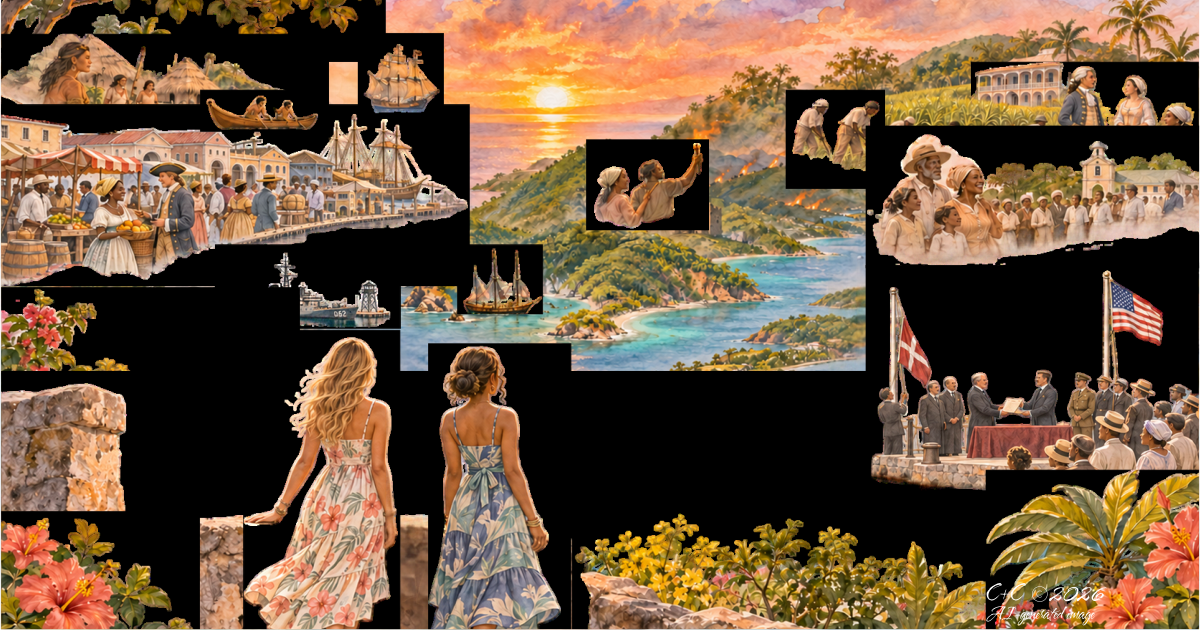
Three Islands, Layered Histories
Three Islands, Many Livelihoods
St. Thomas remains the territory’s administrative and commercial hub. Charlotte Amalie’s harbor, airport, government offices, shops, schools, and medical facilities connect residents across the islands and to the U.S. mainland. While tourism drives a large share of the economy, the island is also home to port workers, small business owners, civil servants, teachers, healthcare staff, and families working well outside the visitor industry.
On St. John, Virgin Islands National Park, white-sand beaches, and protected reefs draw steady crowds, creating jobs for boat captains, guides, taxi drivers, hospitality workers, and local shop owners. At the same time, rapid tourism growth has brought sharp pressures around land prices, affordable housing, and local access to shorelines alongside conservation efforts.
St. Croix blends historic town life, small-scale farming, cultural festivals, and heavy industrial history. When the HOVENSA oil refinery shut down in 2012, the island lost one of its largest private employers and a major source of territorial tax revenue, affecting workers, families, and local suppliers across St. Croix. Subsequent attempts to restart refining operations stalled under federal environmental review, leaving the site's environmental cleanup and economic future unresolved.
Across all three islands, heavy reliance on tourism leaves local livelihoods exposed to global shocks. Visitor arrivals dropped sharply during the COVID-19 pandemic before rebounding through 2024, underscoring both the resilience of the hospitality sector and its vulnerability to outside events.
Hurricanes and the Work of Recovery
The 2017 hurricane season struck the territory with two Category 5 storms in less than two weeks. Hurricane Irma hit St. Thomas and St. John on September 6, followed closely by Hurricane Maria crossing St. Croix later that month. Together, the storms wrecked homes, businesses, hospitals, schools, roads, power grids, and coastal ecosystems.
Rebuilding has stretched across years. Federal and territorial recovery projects have repaired public buildings and upgraded utilities to withstand future storms, though the pace of reconstruction has been uneven across neighborhoods and sectors. Recovery work from Irma and Maria remained active well into 2025, continuing to shape housing, public services, and small businesses.
Culture, Community, and Political Status
Today, the U.S. Virgin Islands is an organized, unincorporated U.S. territory. Residents elect their own governor and a 15-member Senate, along with a delegate to the U.S. House of Representatives who can serve on committees and introduce bills but cannot vote on final passage of legislation. Debates over federal oversight, territorial funding, and local self-determination remain central to public life.
Cultural traditions remain a visible anchor across the islands through quelbe and calypso music, local food, Carnival and festival celebrations, family networks, and traditional crafts passed down across generations alongside modern work and migration.
When we invite people to visit, we are inviting them into places where people live, work, raise families, and care for their communities. A harbor, a market, a neighborhood, or a beach may look picturesque in a photo, but it is also part of someone’s everyday life. Visitors can show respect by learning the islands’ history, supporting locally owned businesses and guides, following community norms, and asking before photographing people. Across St. Thomas, St. John, and St. Croix, that history is still unfolding every day.
Note on Visuals: Historical illustrations in this article were generated using AI. While informed by historical context, visual details are artistic interpretations, as exact appearances, architecture, and daily life cannot be fully confirmed from surviving records.